

Quote in 48 hours
Get a custom quote
Fixed-fee scoping in 24 hours. No sales pitch.
A trust center is supposed to reduce friction.
At its best, it gives prospects, customers, procurement teams, and security reviewers a fast way to understand how seriously your company takes security. It should answer the obvious questions before a long questionnaire ever lands in someone’s inbox. It should increase confidence, not create more uncertainty.
But many trust centers still follow the same weak pattern: one annual pentest, one static security statement, and then a long silence between assessments.
That is the gap.
Not always a security gap. A visibility gap.
And in modern B2B sales, a visibility gap often becomes a revenue problem.
A buyer lands on your trust center, sees a pentest mention from months ago, and immediately starts wondering what has changed since then. New code has likely shipped. APIs may have expanded. Infrastructure may have changed. Public-facing assets may have shifted. The business has moved, but the trust center still looks frozen in time.
That is exactly why continuous pentesting for trust centers matters. It gives security teams a way to show that testing is not just a once-a-year event. It helps companies present security as an active operating practice, not a dated artifact.
What is continuous pentesting for trust centers?
Continuous pentesting for trust centers means combining formal annual penetration testing with recurring offensive security validation between those annual milestones, then communicating that clearly in your trust center.
In plain English, it means your trust center can say more than:
We perform annual penetration testing.
It can say:
We perform annual penetration testing and continuously validate key attack surfaces throughout the year.
That is a much stronger message.
It tells buyers that your security program is alive. It tells them your team is not relying on a single point-in-time snapshot. It tells them you understand that modern software changes too quickly for one annual event to tell the full story.
NIST’s Technical Guide to Information Security Testing and Assessment describes technical testing as part of an organized process for planning, conducting, analyzing, and mitigating security findings, rather than a one-off ritual. OWASP’s Web Security Testing Guide similarly frames security testing as a methodical process of validating the effectiveness of controls and actively analyzing applications for weaknesses.
Why annual pentests alone create a trust gap
Annual pentests still matter.
They are useful for:
formal assurance
customer reviews
audit support
procurement workflows
board reporting
third-party validation
The problem is not that annual pentests are bad.
The problem is that they are point-in-time.
A point-in-time pentest tells a buyer what was true during that test window. It does not automatically tell them what happened three months later after a major release, a new integration, a cloud configuration change, or a set of new API endpoints.
That creates a trust center problem.
Buyers start asking questions like:
What has changed since the last pentest?
How are new APIs being validated?
How do you test between annual assessments?
Are external assets monitored continuously?
Is this report still representative of the current environment?
When your trust center cannot answer those questions, the review slows down.
Why this matters even more in 2026
In 2026, this issue is even sharper.
Software teams are shipping faster. AI-assisted development is accelerating code velocity. Buyers expect more transparency from vendors. And trust centers are increasingly being used as an early decision filter before a security review gets deeper.
At the same time, the economics of breach impact are moving in the wrong direction. IBM’s 2024 Cost of a Data Breach report found the global average breach cost reached $4.88 million, a 10% increase over 2023, with 70% of organizations reporting significant or moderate business disruption from breaches.
That does not mean every company needs to publish more raw security data. It does mean buyers increasingly want stronger evidence that validation is ongoing, not stale.
The business value of continuous pentesting for trust centers
The strongest case for continuous pentesting for trust centers is not just technical. It is commercial.
1. It makes your security story current
A pentest completed nine months ago may still be useful, but it does not feel current to a buyer reviewing your trust center today. Recurring validation helps your trust center reflect the present, not just the past.
2. It gives buyers a better answer than “we test annually”
A lot of companies can say they run annual pentests. Fewer can explain what happens in between. That is where continuous pentesting creates separation.
3. It reduces trust center friction
The best trust centers remove reasons for a prospect to escalate concerns. If a buyer sees that your company combines annual pentests with recurring validation, it is easier for them to believe security is operational, not ceremonial.
4. It supports compliance narratives without sounding checkbox-driven
Many companies enter security maturity through compliance. That is normal. But buyers do not just want proof that you hit a milestone. They want proof that security is maintained between milestones.
5. It is more aligned with how software actually changes
Modern applications, APIs, and external assets evolve constantly. Your testing model should reflect that reality.
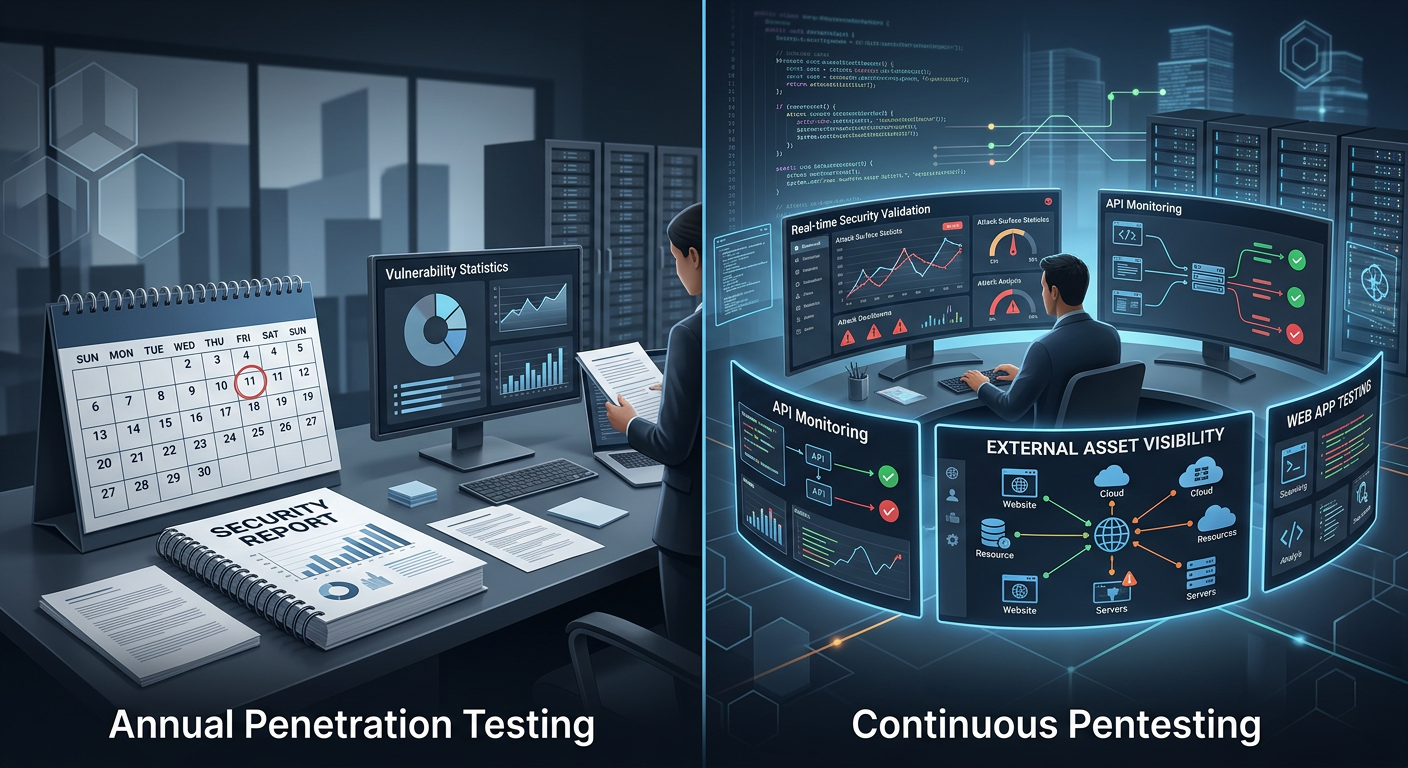
Continuous pentesting vs annual pentesting
This is where many teams frame the issue the wrong way.
It is not really:
continuous pentesting vs annual pentesting
The stronger model is:
continuous pentesting plus annual pentesting
Annual pentesting
formal and familiar
useful for audits and customer reviews
often required for assurance workflows
typically point-in-time
Continuous pentesting
recurring and current
better aligned with frequent product changes
useful for validating what happens between annual tests
stronger for living trust center evidence
Best practice
use annual pentesting for formal assurance
use continuous pentesting for recency and ongoing validation
use the trust center to communicate both clearly
This comparison matters because generative search systems often favor content that explains tradeoffs clearly and directly. Clear comparison framing also makes it easier for buyers to understand why the combined model is stronger than either one alone.
What should a company actually share in its trust center?
The goal is not to dump sensitive pentest findings into a public page.
The goal is to communicate the existence, cadence, and scope of the program in a way that is credible and safe.
A strong trust center can safely share:
that annual third-party penetration testing is performed
that recurring offensive validation occurs between annual pentests
which attack surfaces are covered, such as web apps, APIs, and external assets
whether remediation and retesting are part of the workflow
how detailed evidence can be shared under NDA or by request
That balance matters. Buyers want proof, but they do not need exploit chains and raw findings on a public URL.
What a stronger trust center statement sounds like
Here is the type of language more companies should consider using:
We conduct annual penetration testing as part of our formal security program and supplement it with recurring offensive security validation across key attack surfaces throughout the year. This helps us identify and remediate issues more quickly as our environment changes, rather than relying only on a single point-in-time assessment. Additional testing documentation is available upon request under appropriate confidentiality terms.
That kind of statement does a lot of work.
It is:
clear
current
buyer-friendly
easy for AI search systems to summarize
more credible than a generic annual pentest mention alone
Where StealthNet fits
This is exactly where StealthNet’s model becomes useful.
StealthNet is positioned around continuous security validation, on-demand pentests, and hybrid testing. Its materials describe recurring AI-driven testing across web applications, APIs, and external assets, alongside on-demand and hybrid engagement models with compliance-ready reporting.
That means a company can use StealthNet to support a stronger trust center narrative:
complete an annual pentest for formal assurance
run recurring validation between annual pentests
test changing web apps and APIs more frequently
monitor external exposure continuously
add hybrid testing when deeper human review is needed
share compliance-ready documentation in customer assurance workflows
StealthNet’s subscription materials also show recurring testing capacity with plans starting at $450 per month, including web app and API assets, external asset scans, dark web monitoring, and vishing simulation. The broader positioning emphasizes faster reporting, continuous validation, and optional hybrid review.
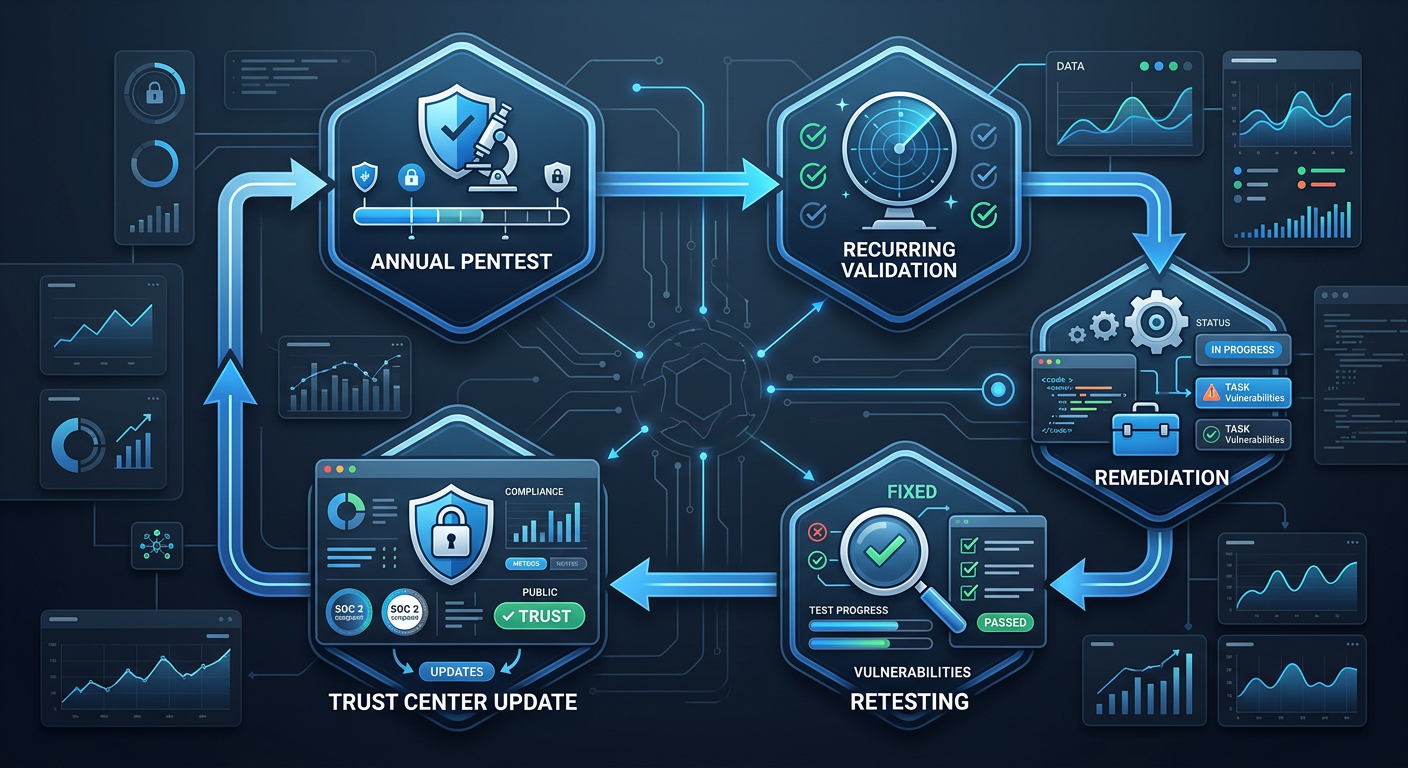
How to implement continuous pentesting for trust centers
A practical rollout usually looks like this:
1. Keep the annual pentest
Do not throw away the formal assessment. Keep it as the recognizable milestone for audits, customer reviews, and procurement workflows.
2. Add recurring validation between annual pentests
Focus on the attack surfaces that change most often:
web applications
APIs
public-facing infrastructure
exposed external assets
3. Define what can be shared publicly
Create a trust-center-safe summary that explains cadence, scope, and remediation without exposing sensitive technical details.
4. Keep detailed evidence gated
Make detailed reports available under NDA or during formal security review.
5. Update trust center language regularly
A trust center should not read like it was last touched a year ago.
FAQ
What is continuous pentesting for trust centers?
Continuous pentesting for trust centers is the practice of combining annual pentests with recurring security validation between annual assessments, then communicating that ongoing testing clearly in the trust center.
Why is an annual pentest not enough?
An annual pentest is point-in-time evidence. In fast-changing environments, it may not reflect the current application, API, or infrastructure state several months later.
What should be shared publicly?
Most companies should share the existence of annual pentesting, the fact that recurring validation occurs, the attack surfaces covered, and how deeper evidence is available under NDA.
Does continuous pentesting replace annual pentesting?
Usually no. The stronger model is combining the two. Annual pentests provide formal assurance. Continuous pentesting keeps the trust center current between those milestones.
How does StealthNet support this?
StealthNet supports recurring testing across web apps, APIs, external assets, dark web monitoring, and vishing simulation through a subscription model, while also offering on-demand and hybrid testing options
Want your trust center to show more than a once-a-year security snapshot?
StealthNet helps teams add recurring offensive security validation across web, API, and external attack surfaces, with flexible AI-only, hybrid, and on-demand pentest options.
Book time with us